Values-safe superapp

Your digital life.
One app.
Values by default.

Short video, social, chat, news, search and AI — together in one superapp. One values standard underneath, shared by Muslims, Christians and Jews.

Safe enough to scroll at the dinner table. Ambitious enough to become much more than a feed.
One standardShared by Muslims, Christians and Jews. Across every miniapp.
One identityVideo, AI, chat, search and more — one account.

Qawqal Shoof short video screen
Qawqal at a glance

One superapp. One values layer. A much bigger ambition.

WhatA values-safe superapp.Multiple everyday digital experiences in one product.
For whomBelievers first.Built around a shared baseline for Muslims, Christians and Jews.
What’s realThe product exists.Qawqal is already software — the superapp is being built one generation at a time.
What’s differentOne values layer.The Standard, moderation and trust travel across the ecosystem.
How we buildTalent density.Small permanent core + selective mission-based Build Classes.
Where it can goFrom attention to ecosystem.Trust first. Transactions and third-party creation later.
The thesis

Not another faith app.

Most faith technology digitised worship. Qawqal starts somewhere else: your values do not switch off when prayer ends, so your feed, search, AI and conversations should not forget them either.

When you prayFaith app ✓
When you scrollMainstream rules
When you searchMainstream rules
When you ask AIMainstream rules
On QawqalOne values layer, everywhere
People don’t become less religious when they open a feed. Why should their technology forget what matters to them?
The Standard, in one screen

Three lines content should not cross. Everything else stays alive.

Qawqal is not trying to remove disagreement, difficult news or ordinary entertainment. The goal is a readable baseline around explicit content, modesty and contempt for faith — with faith-aware treatment where traditions genuinely differ.

Filtered against
Explicit sexual content

A baseline Qawqal can apply across feeds, social surfaces and AI experiences.

Immodesty

Handled with greater context and faith-awareness rather than pretending every tradition uses one identical lens.

Mockery of faith

Disagreement can remain. Contempt and ridicule do not have to be the default culture.

Still welcome
ComedyNewsHonest disagreementBusinessSportLearningOther faiths’ voicesCulture

The Standard is designed to be public, versioned and readable — short enough to understand, specific enough to challenge, and able to evolve when difficult cases teach us something new.

Read the Standard concept →
The product

The idea is already software.

Short video, social, chat, news, search and AI are already being brought together inside one product — with one identity and one values layer.

Qawqal Shoof short videoShoofShort-form video inside the same values layer.
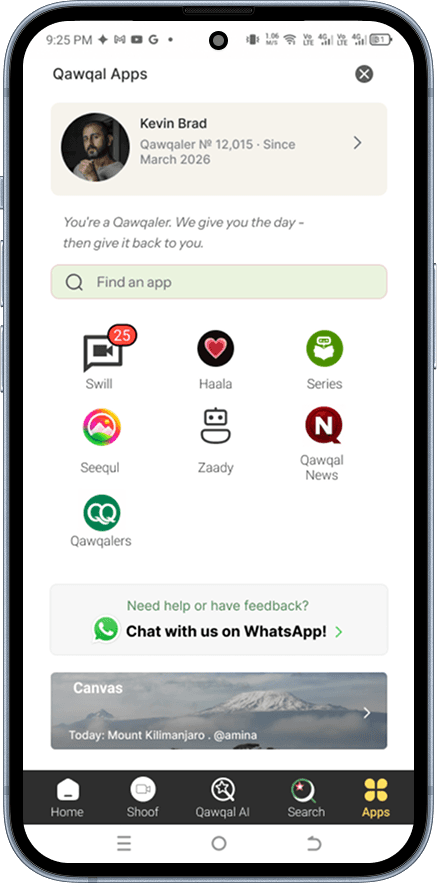
Qawqal miniapps homeOne homeMultiple miniapps, one identity and one experience.
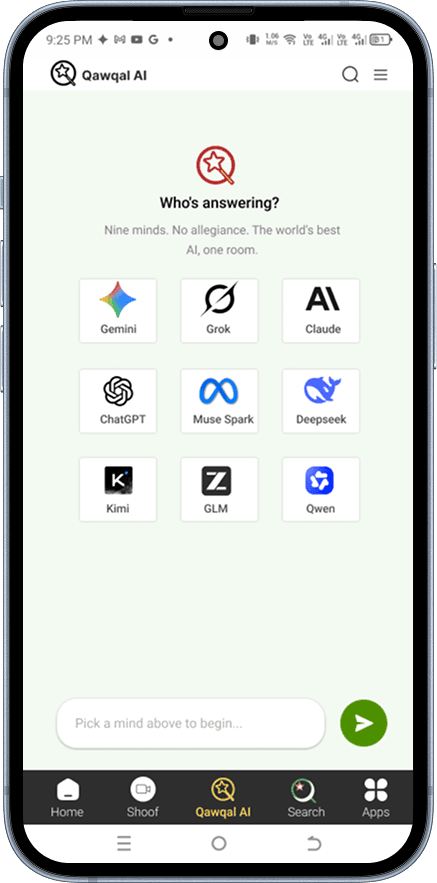
Qawqal AI interfaceQawqal AIAI brought into the same product and trust architecture.
Inside the superapp

Ten miniapps. One login. One standard underneath all of them.

Shipped · live on Google Play

All ten are built. None of this is a concept.

Every miniapp below exists, runs, and has people using it today — not a prototype, not a roadmap, not a design file. One Flutter codebase taken from nothing to a public release in eight months, by three founders, before any institutional capital arrived.

In its first ninety days on Google Play it was downloaded more than 13,000 times, at a five-star rating, with no advertising spend whatsoever. Every one of those installs came from somebody telling somebody else.

The hard part of a superapp is not imagining it. It is shipping ten products that behave like one. That part is done.

13,000+people downloaded it in 90 days
5.0average rating since launch
$0spent on advertising
8months it took to launch
Check it on Google Play →
Short videoShoofThe feed people came for. Every clip is checked before it reaches anyone.
Images & storiesSeequlCreative photography and visual storytelling — the short-video idea, in stills.
Private chatSwillDirect messages and group conversation, inside the same standard as everything else.
Social networkQawqalersPeople, follows and posts — the community layer and the trust graph underneath it.
NewsQawqal NewsMultiple sources, curated by AI, filtered exactly the way the feed is.
Web searchQawqal SearchThe open web, returned without the parts nobody wanted their family to find.
AI modelsQawqal AIThe leading models behind one picker — and every answer passes through the Filter.
Micro-learningSeriesShort lessons built to be finished, in the gaps of an ordinary day.
Worship ZaadyScripture, prayer times, qibla and daily practice — per tradition.
Matrimony HaalaSerious introductions for people looking to marry, not to browse.

Two of the ten are faith-specific. The other eight are ordinary consumer products that happen to be values-safe — and all ten serve Muslims, Christians and Jews.

The next proof

Shipping is proven. Habit is what V2 has to prove.

Thirteen thousand people gave us permission to test the thesis. Downloads prove curiosity; they do not prove habit — and habit is the whole bet. A superapp people install and rarely open is not a partial success, it is a failure with good numbers at the top.

V2 exists to answer the harder question: can Qawqal become somewhere people live, rather than somewhere they visited once?

Underneath the miniapps

What matters isn’t ten apps. It’s what they share.

ExperienceVideo · Social · Chat · News · Search · AI
IntelligenceDiscovery · Models · Personalisation
TrustThe Standard · Moderation · Appeals
FoundationIdentity · Content graph · Infrastructure
Shared where values overlap.

A common baseline without pretending the traditions are identical.

Faith-aware where they differ.

Different contexts can require different interpretations, especially around modesty.

Governed, not guessed.

AI can screen at scale; hard edge cases still need policy, review and a path to appeal.

Compounding with use.

Hard decisions can improve the taxonomy, evaluation data and future systems.

The big vision

Ten miniapps are the on-ramp.

Every superapp that ever mattered climbed the same ladder: win the hours, earn the trust, carry the money, then let everybody else build on top. Nobody has climbed it for the world’s believers.

Qawqal is on the first rung. The rest of the ladder is already drawn.

Today

Attention

Video, social, chat, news, search and AI in one app.

Live on Google Play
Next

Trust

Identity, reputation, creators and communities under one standard.

The trust graph
By 2030

Qawqal Pay

Giving, remittances, commerce and services on rails we own.

The wallet rung
Endgame

Ecosystem

Thousands of teams building on Qawqal’s identity, payments and trust.

Rails, not products

Facebook built the social graph. Qawqal is building the trust graph.

Phase two · Qawqal Pay

WeChat Pay wasn’t born from banking. It was born from a gift.

In 2014 WeChat digitised the red envelope — the small sum handed over at new year. Millions of people attached a bank card in order to send one, and in a single season a messaging app became a payment network.

Qawqal’s users already have that ritual. They have four of them, and they do not wait for new year.

IslamZakat & sadaqahAn obligation and a habit. Given through the year, and heavily during Ramadan.
ChristianityTithing & offeringWeekly, at services attended by hundreds of millions of people.
JudaismTzedakahA duty of giving woven into the calendar and the week.
All threeSending money homeThe other transfer believers make constantly — to family, across borders.

Every gift onboards a payment credential. Giving is the on-ramp — remittances, commerce and services are what the rails carry once they exist.

$200B–$1TEstimated zakat given each year. Formal financial rails capture $10–15B of it.UNDP · World Zakat Forum
$151.6BGiven to religious causes in the United States in 2025 — the largest single category of charitable giving.Giving USA, 2026
$685BSent home by migrant workers to low- and middle-income countries in 2024 — more than foreign investment and aid combined.World Bank · KNOMAD

The gap between what believers already give and what currently touches a formal payment rail is not a market Qawqal has to create. It is one that exists and is being served badly.

From “I trust Qawqal”
to “I move money through Qawqal.”

Endgame · the ecosystem

Qawqal will not build the Uber.
It will be the place the Uber runs.

Somebody will build the values-aligned rides company. Somebody will build the halal-and-kosher marketplace, the pilgrimage travel platform, the family-safe learning app. None of them should have to build an audience, an identity system, a payment rail and a trust standard from zero first.

Partner-runRidesTransport built by operators who know their cities, reaching riders who are already signed in.
Partner-runStays & travelPilgrimage, family travel and hospitality that already has to meet a standard.
Partner-runMarketplaceHalal and kosher commerce, where certification is the product and trust is the moat.
Partner-runServicesLearning, health, finance — anything a values-aligned team wants in front of the same audience.

Qawqal’s job is the layer underneath: one identity, one wallet, one values standard, one audience — and a platform fee on every transaction that crosses it.

Attention earns trust. Trust carries money. Money turns a superapp into an economy.

The money

It already makes money. Deliberately, not much.

Qawqal has been charging since launch. The number is small, and that is the point — V1 existed to prove that people would pay at all, not to extract from thirteen thousand early users.

V2 is where monetisation actually starts. There are five engines. One is live, one is in beta, three are years out. All five are below.

Live01 · Premium$5 a monthCharging since launch. The first subscribers converted at the paywall with no promotion at all — willingness to pay stopped being a hypothesis.
With scale02 · Values-safe advertising$0.225 per user / monthThe inventory is brand-safe by construction rather than by moderation spend. Advertisers pay a premium for that, not a discount.
In beta03 · Digital goodsCreator commerceCards and collectibles inside a beta miniapp, with first sales already made. This is what actually paid for WeChat — not the messaging.
From 203004 · Qawqal PayWallet & transfer feesA margin on money moving through the wallet, once weekly giving has brought the payment credentials in.
Endgame05 · Platform feeA take on every transactionA percentage of what partners run through the rails. No inventory, no logistics, no support burden — the margin structure that makes platforms worth more than the products on them.
The arithmetic, in the open

What one user is worth in a year.

5% on premium$5 / month$60 a year
95% on values-safe ads$0.225 / month$2.70 a year
Per monthly active user≈ $5.60 a year
100Kactives ≈ $560K a year
1Mactives ≈ $5.6M a year
10Mactives ≈ $56M a year

This is arithmetic, not a forecast. It shows what a user is worth, not when they arrive. And it counts two engines out of five — digital goods, Qawqal Pay and the platform fee are all set to zero in that maths, which is precisely where WeChat’s value ended up.

A company with no revenue model is renting time from its investors. Qawqal intends to earn its own.

Why now

Nobody built this because until recently nobody could.

A values-safe superapp is an obvious idea. It stayed unbuilt because it needed AI to solve two different problems at once — judging content at scale, and building software at scale — and then needed the market to arrive. All four became true inside about three years.

01 · Multimodal AIThe Filter became buildable.Reading every upload against a written standard used to mean humans reading everything. Multimodal AI — models that can watch a video and judge what is in it — now does that work at a scale no moderation team could reach. TikTok’s systems already remove the overwhelming majority of violating content before anyone reports it.
02 · AI coding toolsThe team became small enough.AI coding tools have collapsed what a small team can ship — Claude Code, Cursor and GitHub Copilot each crossed $1B in annual revenue in 2025–26. Midjourney reached roughly $200M with about eleven people; Cursor passed $500M ARR with under fifty. Breadth stopped being a headcount problem.
03 · Market proofThe category stopped being a theory.Hallow became the first faith app to enter the App Store top ten, reaching third overall — above Netflix and TikTok. Muzz turned roughly $9M raised into more than 15 million members. Believers pay for products built around their values.
04 · The audienceThe world is not secularising.Pew projects the religious share of the world’s population to rise rather than fall, and the fastest-growing internet populations are among the most religious on earth. The next billion people to come online are believers.

Sam Altman keeps a running bet with other technology chief executives on the first year somebody builds a billion-dollar company alone — an outcome he has called unimaginable without AI. Qawqal does not need that bet to land. It needs something far more modest to be true.

And the ones who could copy it

Values-safety is easy to copy as a toggle. Hard to copy as a default.

Qawqal is built around the constraint from the architecture upward. For a platform whose recommendation objectives and ad inventory are tuned to a different philosophy, making that constraint the default means shrinking its own inventory and retraining its algorithm against its own revenue. A settings toggle is cheap. A default is a business model.

Read the Standard →

Twelve people can now build what used to take two hundred.

Three founders and nine builders. That is the whole company that ships V2 — and the reason a ninety-day class is a serious plan rather than a hopeful one.

How Qawqal grows

The model. The opportunity. The people.

Talent density over headcount: a deliberately small permanent core that expands around missions, the engineers who take those missions on, and a permanent record of everyone who moved Qawqal forward. Three different ideas, three different doors.

For investors & accelerators

See the platform before the numbers make it obvious.

Qawqal is built around a simple but ambitious thesis: values can become a product primitive across everyday digital life. If that works, the opportunity extends from attention to identity, trust, transactions and eventually an ecosystem other builders can create on.

Detailed traction, economics and fundraising materials are available privately to serious investors and accelerator partners.

Request investor materials →
Talk to us